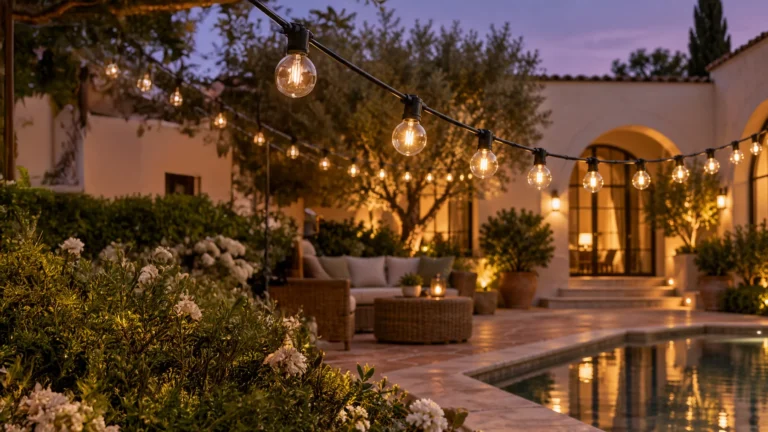

For retailers, distributors and hospitality buyers, the right ST38 solar string lights must fit both the installation and the purchase plan. A familiar bulb shape alone cannot tell you whether a set will deliver the light, runtime or serviceability you need.
Use this guide to define your requirements, compare complete systems and agree what to check before bulk supply.
Quick Buying Checklist
- Define the job: application, illuminated length, bulb spacing and nightly operating hours.
- Specify useful performance: light color, brightness, charging arrangement and runtime at the chosen setting.
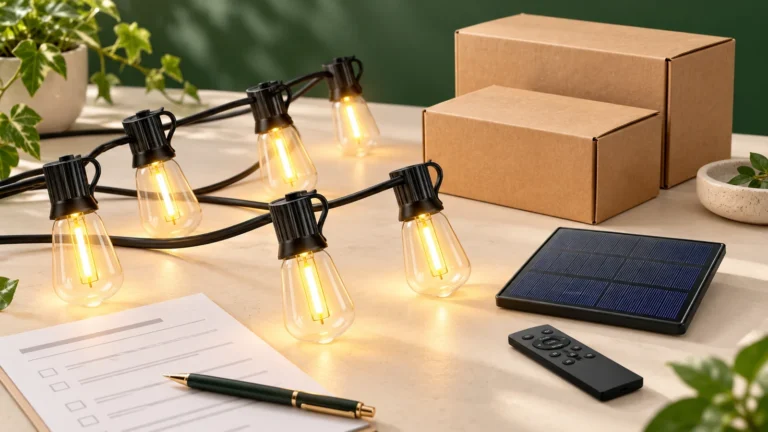
- Check the complete set: light string, solar control box, panel, battery, connections and included accessories.
- Set the purchase brief: destination market, quantity range, packaging or branding, sample needs and required delivery date.
- Agree the evidence: model-specific specifications, applicable documents and sample acceptance conditions.
Follow three stages: plan the purchase, compare performance, then approve the sample and order details.
What Does ST38 Tell You?
ST38 is a bulb shape or format designation. It does not establish the complete system’s brightness, runtime, charging performance or outdoor protection.
Products sold under the same ST38 description can have different panels, batteries, cables and controllers. Replacement bulbs may also have different electrical requirements.
Compare complete systems, and identify the exact model on every quotation.
Couleelight ST38: Start with a Complete-System Brief
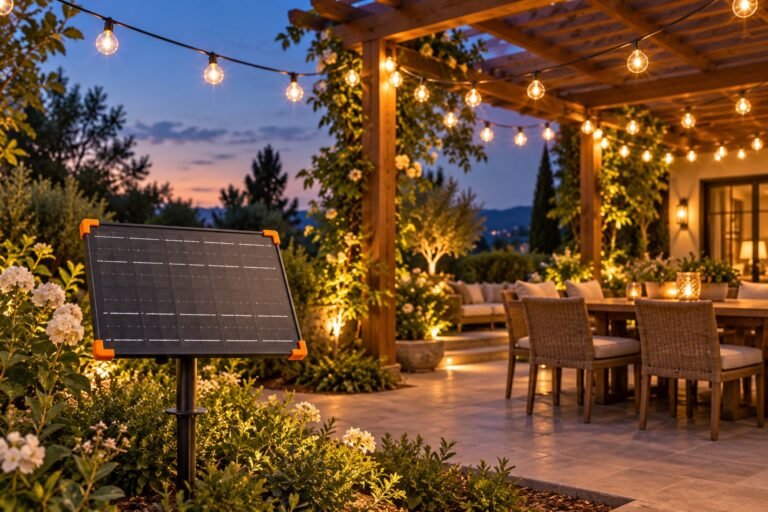
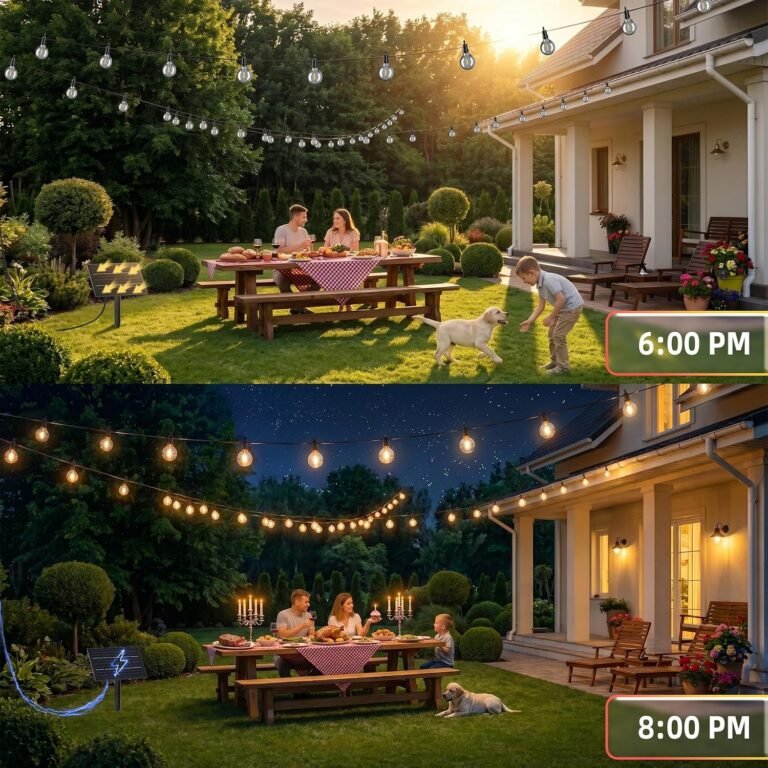
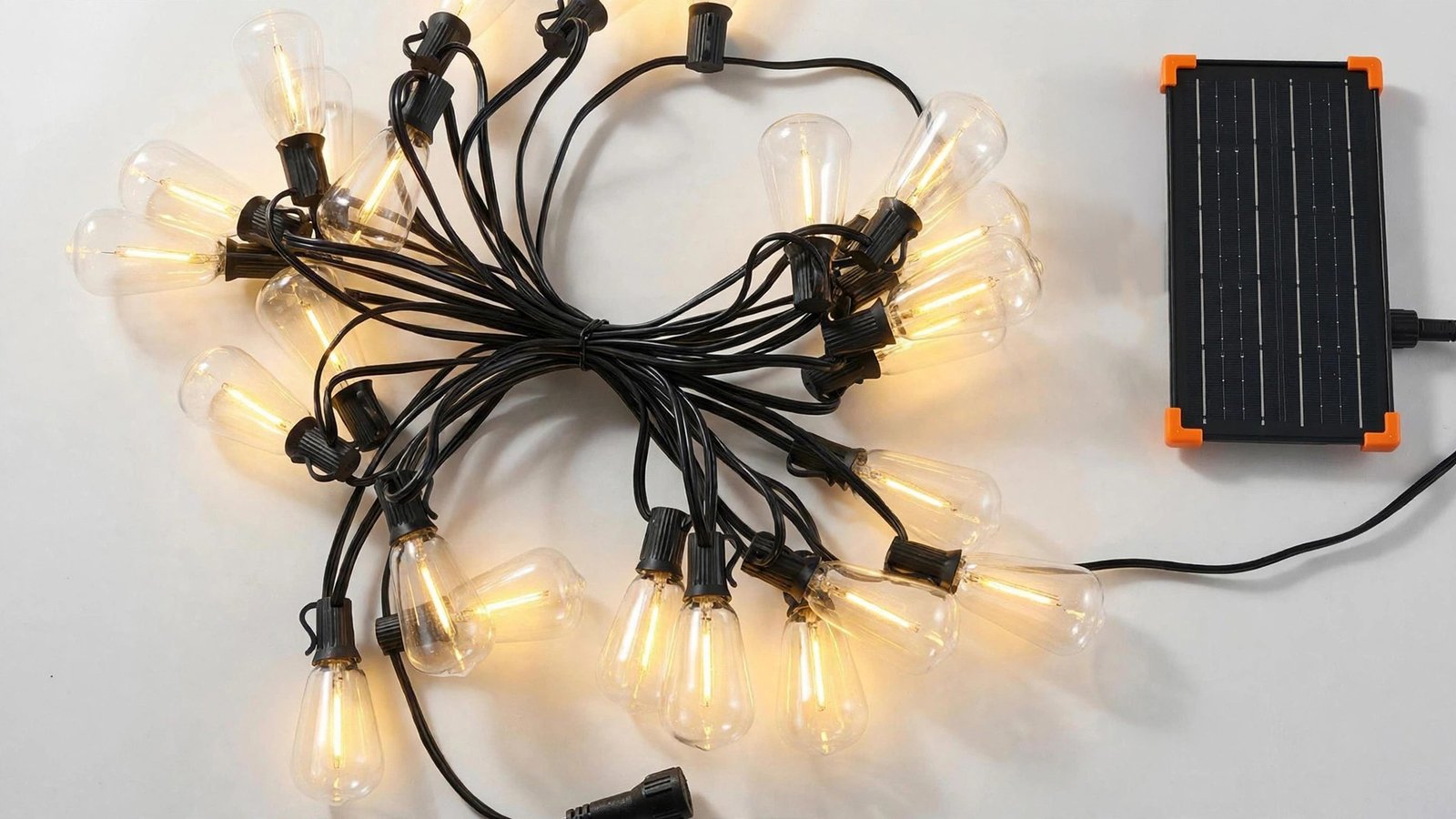
Couleelight produces and sells ST38 solar string lights with a Solar Control Box. The illuminated product photograph above shows a supplied Couleelight product; the garden scene below illustrates an application.
For your selected configuration, ask us to confirm the light string, control box, solar panel, battery and supplied accessories together. Include your quantity, target market and sample requirements so the discussion covers the purchase as well as the product.
Discuss your ST38 requirements with Couleelight and request the specifications, available options and sample arrangements for your brief.
See the Solar String Light Components
This short video from Couleelight shows a solar string light set and its components. Use it as a visual introduction, then confirm the configuration and specifications for your order.
Stage 1: Plan Your ST38 Purchase
Before comparing prices, give suppliers the same commercial brief: destination market and sales channel, estimated quantity, packaging or private-label needs, sample requirements and target delivery date. Ask for MOQ, sample cost and timing, and the production schedule for the proposed configuration.
Retail buyers should define the pack contents and customer instructions. Hospitality buyers should define the installation and daily operating routine. Both need a clear plan for replacement parts and after-sales support.
1. Define the Space and Evening Schedule
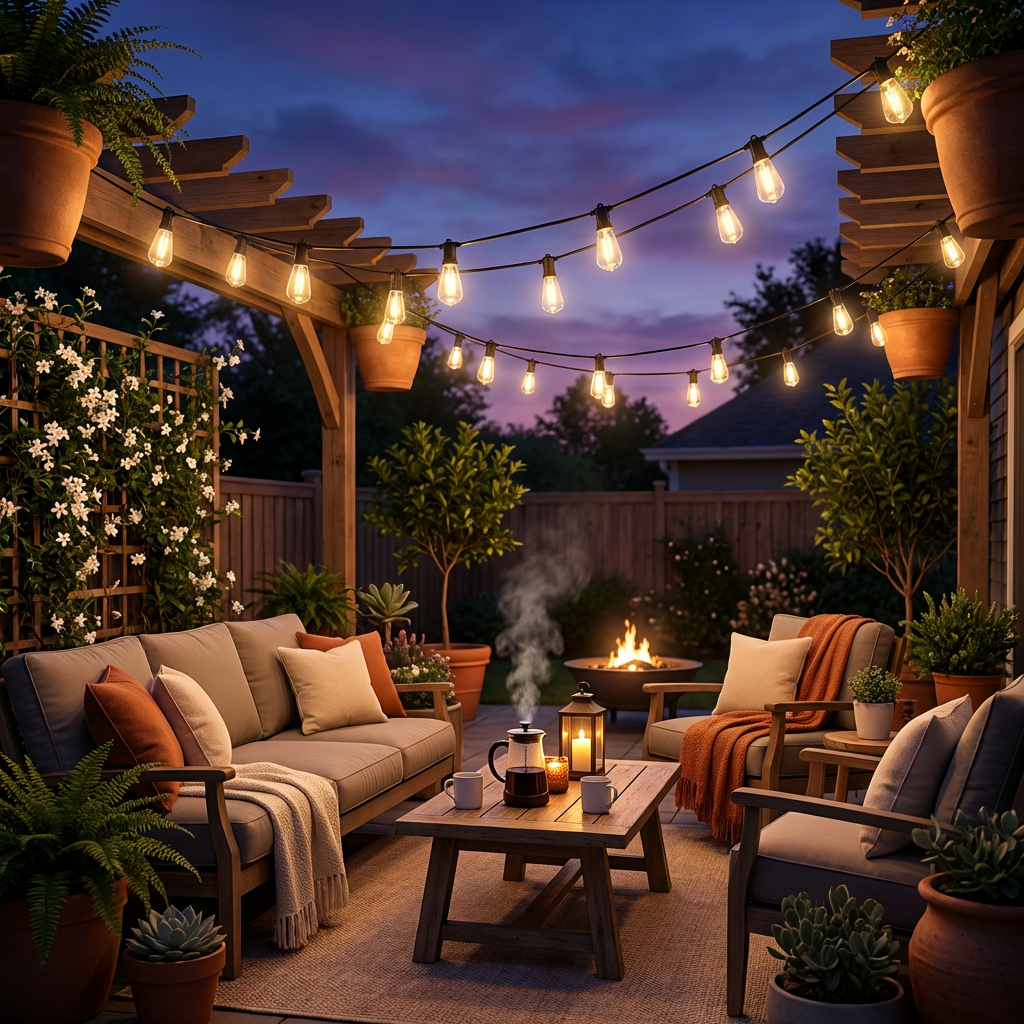
Start with a simple description of the job:
A café terrace needs warm decorative lighting from 6 p.m. to 11 p.m., with controls staff can reach easily.
This establishes an operating period, a lighting purpose and a practical control requirement.
Plan the solar panel position separately from the hanging route. Bulbs may sit beneath a canopy while the panel needs direct sunlight. Measure the distance from the panel position to the first bulb, and confirm that the lead cable can reach.
Buyer takeaway: plan the bulb layout and panel position together.
2. Check Illuminated Length and Bulb Spacing
A “15 m string” is difficult to compare unless you know what the measurement includes. Ask for a layout drawing showing:
| Measurement | What it means for your installation |
|---|---|
| Total length | The complete cable length |
| Illuminated length | The section carrying the bulbs |
| Lead cable | The distance from the panel or controller to the first bulb |
| Bulb spacing | How closely the lights are arranged |
| Bulb count | How many lit points the set provides |
For example, 25 bulbs spaced 0.5 m apart have 24 gaps, giving 12 m between the first and last bulbs. Lead and tail cable are additional measurements.
Measure along the hanging route, including drapes and curves. Confirm whether sets can be connected; an end connector alone does not establish that another string can be added.
Buyer takeaway: compare the same length measurements across every quotation.
Stage 2: Compare Light, Power and Outdoor Performance
Compare the exact model and complete configuration in each quotation. Use the following checks to turn marketing descriptions into specifications you can review.
3. Separate Warm Color from Brightness
Color temperature describes how warm or cool the light appears. Lumens describe light output. These specifications answer different questions.
A 2700K specification indicates a warm light tone; it does not establish how brightly the string will illuminate a terrace. For any lumen figure, confirm whether it applies to one bulb or the complete string, and at which brightness setting it was measured.
View the sample at the intended hanging height, both from the seating area and from a distance. A decorative glow may suit a garden feature, while a dining area may need additional lighting for reading menus.
Buyer takeaway: approve light color and useful brightness separately.
4. Compare Runtime at Your Chosen Brightness
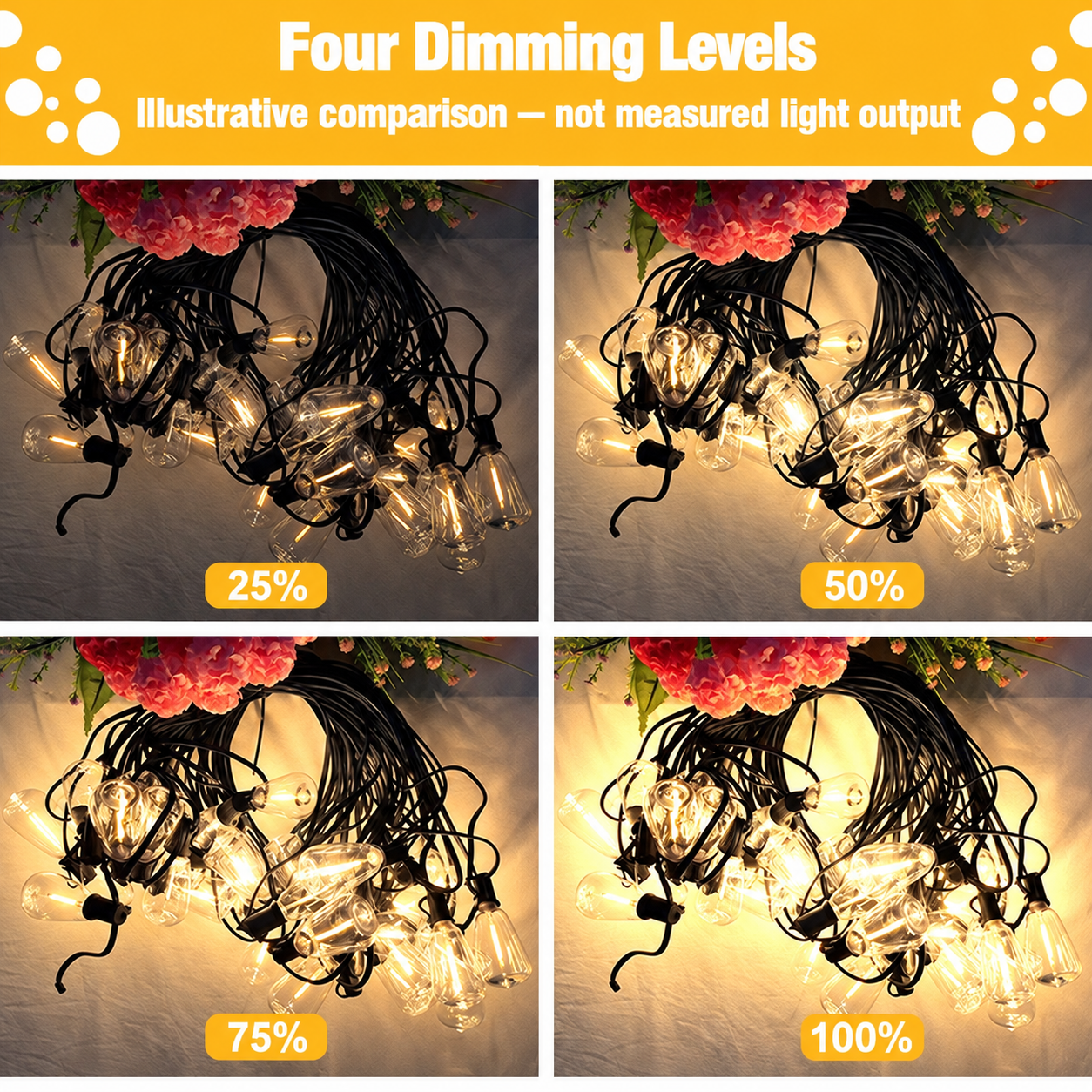
“Up to 10 hours” leaves a key question unanswered: at what brightness? A long runtime at a low setting may not meet a venue’s lighting needs.
Ask the supplier to record:
- Starting battery charge.
- Brightness setting and lighting mode.
- Test temperature and environment.
- Whether runtime ends at switch-off or at an agreed minimum brightness.
For a café operating five hours after dusk, check whether the sample maintains an acceptable lighting effect for that period at the intended setting. Keep these conditions beside any runtime claim.
The photograph has been digitally adjusted to illustrate four dimming levels. It is not a measured brightness comparison. A 50% setting does not establish half the measured lumens or twice the runtime of a 100% setting. Confirm the available settings and test each setting on the selected model.
Buyer takeaway: compare runtime at a useful brightness, with the test conditions recorded.
5. Decide Whether USB Backup Fits Your Routine
Solar charging depends on available sunlight. Shade, weather and seasonal conditions can affect the energy collected. For fixed events or regular hospitality use, consider whether USB backup would make preparation easier.
If USB charging is offered, confirm:
- Connector type and required input.
- Charging time under stated conditions.
- Whether a cable and power adapter are included.
- How staff will access the charging port.
- Whether operation during charging is permitted.
A USB port offers limited convenience if reaching it requires taking down the installation.
Request panel rated power and battery chemistry, voltage and capacity. Ask for battery capacity in watt-hours when comparing systems with different battery voltages.
Buyer takeaway: choose a charging arrangement that someone can realistically manage.
6. Test the Controls You Will Use Every Day
For a restaurant or garden seating area, steady light, suitable dimming and predictable timing may matter more than numerous flashing modes.
| Question | Why it matters |
|---|---|
| Does the remote work from the intended position? | Staff may operate lights mounted overhead |
| Are brightness and mode settings remembered? | Repeated setup can become inconvenient |
| When does the timer start? | A six-hour timer may not start at sunset |
| Does the timer repeat automatically? | This affects the daily operating routine |
| Does one remote operate several sets? | Group control may help, or interfere with separate zones |
Also check how dusk sensing interacts with manual operation, following the model’s instructions.
Buyer takeaway: test the operating routine, not just the buttons.
7. Check Outdoor Protection by Component
A set includes bulbs, sockets, cable, a panel, electronic enclosures and connections. Ask which parts the stated protection rating covers.
A rating listed for the solar panel should not automatically be applied to the complete set. Request documentation identifying the quoted model, the tested components and the installation conditions, including any requirement to close charging-port covers.
Material claims also need detail. “Plastic housing” does not identify the bulb envelope material. If replacement bulbs are offered, confirm their electrical compatibility, availability and ordering details.
Buyer takeaway: request model-specific documentation and a clear replacement-parts policy.
Stage 3: Approve the Sample and Order Details
Use One Supplier Comparison Checklist
Send the same requirements to each supplier so quotations answer the same questions.
| Confirm | Record |
|---|---|
| Application | Installation location, lighting purpose and nightly schedule |
| Layout | Illuminated length, total length, lead cable, bulb count and spacing |
| Light | Color temperature, output measurement basis and approved appearance |
| Power | Panel specifications, battery details and charging options |
| Runtime | Duration at the agreed brightness and mode |
| Controls | Remote, dimming, timer, memory and dusk-sensing behavior |
| Outdoor use | Component ratings, supporting documents and installation conditions |
| Purchase plan | Quantity, MOQ, destination market, packaging, branding and delivery schedule |
| Sample approval | Sample configuration, cost, timing, acceptance conditions and reference sample |
| Order support | Included accessories, replacement parts and warranty terms |
For wholesale orders, also confirm minimum order quantity, packaging, lead time and destination-market documentation. Keep unanswered questions visible until they are resolved.
For further guidance, read our OEM supplier checklist and guide to customization for your brand.
Approve a Sample Against Written Conditions
Check layout, light appearance, controls and runtime from a full charge. Then assess solar charging at a representative site over several day-and-night cycles. Record the settings, conditions and results so the evaluation is repeatable.
Before bulk production, agree the specification, pack contents, labels, manual and any branding artwork. Identify the approved sample and the inspection requirements in the order documents. If a component or configuration changes, confirm whether sample approval needs to be repeated.
Quick Answers for Buyers
Do all ST38 solar string lights have USB charging?
No. USB charging is model-specific. Confirm the connector, input requirements and supplied accessories.
Can multiple sets be connected?
Only when the selected product explicitly supports it. Ask for the permitted arrangement and maximum supported configuration.
Does a longer advertised runtime mean a better product?
Not necessarily. Compare brightness, mode and test conditions first. What matters is how long the lights provide the effect your application needs.
What is the simplest way to evaluate a sample?
Check the layout, appearance, controls and runtime from a full charge. Then assess solar charging at a representative site over several day-and-night cycles. These checks evaluate different aspects of performance.
Discuss Your Requirements with Couleelight
Use this enquiry template to start a practical configuration discussion:
We are sourcing ST38 solar string lights for [application and destination market]. We need [illuminated length], [bulb count or spacing] and [operating hours] each evening. Charging preference: [solar / solar with USB backup]. Expected quantity: [quantity]. Packaging or branding: [requirements]. Samples needed by: [date]. Target delivery: [date]. Please confirm the configuration, sample details, runtime conditions, outdoor protection documents and quotation.
Share your brief so we can discuss available options and the checks to include in sample evaluation.